Phone number
Email address
Inertia-Driven (Kinetic System) Semi-Auto Shotguns
- Firearms Manufacturer
- Kinetic System Semi Auto Shotgun Manufacturer
Our Inertia-Driven Shotgun Models
The grid shows our walnut field guns, IB-KS01 to KS04. The IUE-KS field, sport and tactical models are listed in the model table in the guide further down this page.

IB-KS01
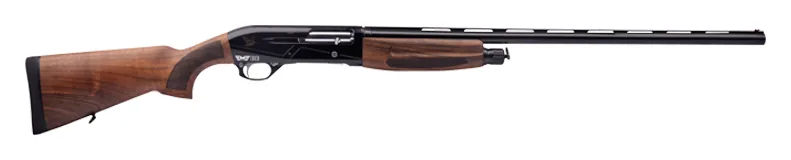
IB-KS02

IB-KS03
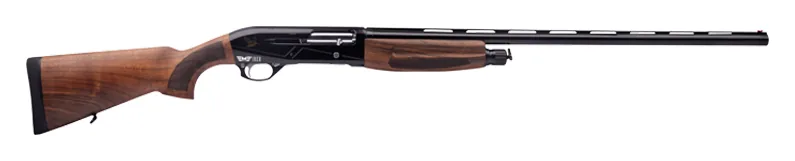
IB-KS04
Inertia Shotgun Specifications
| Specification | IB-KS01 to KS04 | IUE-KS-28 to 31 | IUE-KS-32 to 37 |
|---|---|---|---|
| Action | Inertia-driven (Kinetic System) | Inertia-driven (Kinetic System) | Listed as “TDI DU-PI Kinetic Gas Operated” semi-auto |
| Role | Walnut field guns | Field and sport | Tactical |
| Gauge / chamber | 12 ga, 76 mm (3″) | 12 ga, 76 mm (3″) | 12 ga, 76 mm (3″) |
| Barrel lengths | 47, 51, 55, 61, 71 cm (18.5 to 28″) | 47, 51, 66, 71 cm (18.5 to 28″) | 47, 51, 61 cm (18.5 to 24″) |
| Barrel | 4140 steel | 4140 steel | Perforated 4140 steel (as listed) |
| Receiver | Aluminum alloy | Aluminum alloy | T6 7075 aluminum |
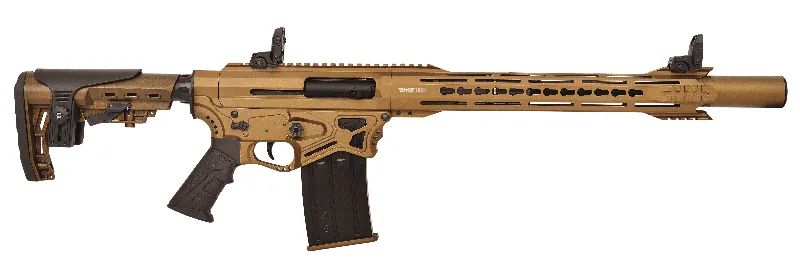
| Stock | Turkish walnut | Synthetic or wood | Collapsible, pistol-grip or fixed synthetic |
| Capacity | 2+1, 4+1 | 4+1, 7+1, 10+1 | 5+1, 7+1 |
| Chokes | Mobil-type tubes; slug option | Mobil-type tubes; slug option | Mobil-type tubes |

Inertia Shotgun Manufacturer in Türkiye
An inertia shotgun (inertia-driven semi-auto) is a self-loading shotgun that uses the gun’s own recoil, not propellant gas, to cycle the action. A spring between the bolt body and bolt head stores recoil energy, then unlocks the bolt to start reloading. Iber Arms calls its inertia system the Kinetic System.
We build 14 inertia-driven models in Beyşehir, Türkiye, with walnut field guns (IB-KS01 to KS04), field and sport guns (IUE-KS-28 to 31) and tactical versions (IUE-KS-32 to 37), plus the M2-style ADA 2. All are 12 gauge with 76 mm (3″) chambers, supplied to importers, distributors and licensed dealers.
Our features
What Makes an Inertia Shotgun Different?
An inertia gun has no gas ports, piston or cylinder. Propellant gas leaves through the muzzle, so the action stays cleaner, there are fewer parts to wear, and the gun is usually lighter and slimmer through the forend, which hunters notice on long walks.
The trade-offs are real. Felt recoil is sharper than with a gas gun of the same weight, very light loads may not cycle reliably (especially in a new gun), and the gun must be free to recoil against a firm shoulder. Heavy accessories can also affect cycling.
Because we make both systems, we can recommend inertia or gas according to how your customers shoot. Compare gas vs inertia shotguns.
INQUIRY FORM
Inertia Shotgun FAQ
What is an inertia shotgun?
An inertia shotgun is a semi-automatic that uses the recoil of the gun, rather than propellant gas, to cycle. When it fires, a heavy bolt body lags behind the recoiling gun, compresses a spring and then unlocks the bolt, which extracts, ejects and reloads. Inertia guns are typically lighter, cleaner and simpler than gas guns, but they feel sharper in recoil.
Is "Kinetic System" the same as inertia-driven?
Yes. Kinetic System is the name we use for our inertia-driven semi-autos, in which the kinetic energy of recoil runs the action. Searchers and most of the industry call the same principle “inertia-driven” or “inertia-operated”. Our tactical IUE-KS-32 to 37 are listed as “TDI DU-PI Kinetic Gas Operated”, so ask our export team for the technical documentation of that system.
Which has less recoil, a gas or an inertia shotgun?
With the same load, a gas-operated shotgun usually feels softer. The gas system spreads the recoil impulse over a longer time, and gas guns tend to be heavier. An inertia gun is lighter and needs recoil to cycle, so it feels sharper, especially with heavy loads. Many hunters accept that trade for the lighter carry weight.
Why won't my inertia shotgun cycle?
The most common causes are a loose hold, light target loads, added weight (lights, optics, side-saddles, magazine extensions), stiff springs in a new gun, a bolt eased forward instead of released, and thick oil or dirt on the bolt. Mount firmly, try a heavier load, remove accessories and clean the action. If it still short-cycles, have it inspected.
Do inertia shotguns need a break-in period?
Many do. New springs and contact surfaces are stiff, so light loads may not cycle reliably at first. Firing a few boxes of standard hunting loads usually lets the action settle. After break-in, test the specific light loads you intend to use before buying them in bulk.
Can an inertia shotgun shoot light target loads?
Often yes, once broken in, but light, low-velocity target loads are the most likely to short-cycle in any inertia gun, and the margin shrinks if the gun is heavy or fitted with accessories. If you mainly shoot high volumes of light loads at clays, a gas-operated semi-auto is usually the more forgiving choice.
Are inertia shotguns good for waterfowl hunting?
Yes, they are widely used for waterfowl. With no gas system, there are fewer parts for mud, water and carbon to foul, and heavy waterfowl loads give strong recoil for reliable cycling. Keep lubrication light in cold weather, dry the gun after use and choose a synthetic stock for blinds and boats.
Who invented the inertia-driven shotgun system?
The inertia-driven system is credited to an Italian gun designer, and semi-autos have been built around the principle for decades. Today many manufacturers, including Turkish factories such as ours, produce inertia shotguns based on the same basic idea of a bolt body, inertia spring and rotating bolt head.
Can I add a light or magazine extension to an inertia shotgun?
You can, but every gram you add reduces how fast the gun recoils, and an inertia action needs that movement to cycle. Lightweight accessories with standard or heavy loads usually work; heavy lights, long extensions and loaded side-saddles combined with light loads can cause short-cycling. Test the complete configuration with your duty or hunting ammunition.
Do you sell inertia shotguns to private buyers?
No. Iber Arms supplies importers, distributors, licensed dealers and government or law-enforcement buyers only. If you are a private buyer, please ask a licensed dealer or importer in your country. Trade buyers can request quotations and samples through our inquiry form.
Can you build Kinetic System shotguns under our brand?
Yes. We supply inertia shotguns as OEM or private label with your logo and your choice of stock, finish, barrel length and capacity. Evaluation samples are available, and we accept orders of any quantity. Ask our export team which proof marks and certificates are available for your market.
How Inertia-Driven Shotguns Work, Plus Pros, Cons and Care
Inertia shotguns at a glance
- What it is a semi-automatic shotgun that cycles on recoil (inertia) instead of propellant gas.
- Our name for it Kinetic System.
- Models IB-KS01 to KS04, IUE-KS-28 to 37, plus the M2-style ADA 2.
- Gauge and chamber 12 gauge, 76 mm (3″).
- Barrels 47 to 71 cm (18.5 to 28″), 4140 steel.
- Capacity 2+1 to 10+1 depending on model.
- Best suited to upland and waterfowl hunting and long days afield; tactical versions for duty use.
What is an inertia-driven shotgun?
An inertia-driven shotgun is a semi-automatic that uses recoil, not gas, to reload itself. “Kinetic System” is our name for the same principle, in which the kinetic energy of recoil runs the action. If you searched for a “kinetic shotgun”, note that the phrase mostly refers to video-game weapons. In the firearms trade the system is called inertia-driven or inertia-operated.
The design is credited to an Italian gun designer and has been in use for decades. Today many manufacturers, including several in Türkiye, build inertia shotguns on the same principle.
How does an inertia shotgun work?
The heart of the system is a two-part bolt, made up of a heavy bolt body and a rotating bolt head, with a short, stiff inertia spring between them. Here is how it works, step by step.
- Firing and recoil. The shell fires and the whole gun starts to recoil rearward into the shooter’s shoulder.
- The bolt body lags behind. Because of its inertia, the bolt body tends to stay where it is while the gun moves back around it. Relative to the receiver it moves forward, compressing the inertia spring against the locked bolt head.
- The spring rebounds. The compressed spring pushes the bolt body rearward again. As it moves back, it rotates the bolt head out of its locking recess, by which time chamber pressure has dropped.
- Extraction and ejection. The bolt assembly travels rearward, pulls the empty hull from the chamber and ejects it, compressing the recoil spring (in many designs housed in the buttstock).
- Feeding and lock-up. A new shell is released onto the carrier; the recoil spring drives the bolt forward, the shell is chambered and the bolt head rotates back into lock.
The whole cycle takes a fraction of a second, and recoil is its only energy source. That is why inertia guns are clean and simple, and also why anything that reduces the gun’s rearward movement, such as a soft hold, added weight or a very light load, can interrupt the cycle.
Gas vs inertia at a glance
| Factor | Inertia (Kinetic System) | Gas-operated |
|---|---|---|
| Energy source | Recoil of the gun | Propellant gas tapped from the barrel |
| Felt recoil | Sharper | Softer, longer impulse |
| Weight | Usually lighter | Usually heavier |
| Cleaning | Action stays cleaner | Gas ports, piston and cylinder collect carbon |
| Light target loads | May short-cycle | Usually cycle |
| Lights, optics, extensions | Added weight can affect cycling | Little effect |
| How the gun is held | Needs a firm shoulder | Less sensitive |
| Typical uses | Upland, waterfowl, carry-heavy hunting | Clays, high-volume and tactical shooting |
Read the full gas vs inertia shotgun guide, or browse our gas-operated semi-auto shotguns.
Advantages and disadvantages of inertia shotguns
Advantages
- Clean-running, because gas exits through the muzzle instead of entering the action
- Fewer parts, with no piston, cylinder or gas seals
- Lighter weight and a slimmer forend for long walks
- Fast, positive cycling with full-power hunting loads
- Fewer places for fouling and moisture to collect
Disadvantages
- Sharper felt recoil, especially with heavy loads in a light gun
- May short-cycle very light target loads, particularly before break-in
- Needs a firm shoulder; awkward positions can cause stoppages
- Heavy accessories can affect cycling
- The bolt must be released fully, not eased forward, to lock
Our Kinetic System shotgun models
All our inertia shotguns are 12 gauge with 76 mm (3″) chambers, 4140 steel barrels and Mobil-type choke tubes. Options shown are those listed on each product page.
| Model | Type | Stock / finish | Barrel options | Capacity |
|---|---|---|---|---|
| IB-KS01 | Field | Black receiver, Turkish walnut, ventilated rib | 47 to 71 cm (18.5 to 28″) | 2+1, 4+1 |
| IB-KS02 | Field | Black receiver, Turkish walnut | 47 to 71 cm (18.5 to 28″) | 2+1, 4+1 |
| IB-KS03 | Field | Silver-gray receiver, Turkish walnut | 47 to 71 cm (18.5 to 28″) | 2+1, 4+1 |
| IB-KS04 | Field | Black receiver, Turkish walnut | 47 to 71 cm (18.5 to 28″) | 2+1, 4+1 |
| IUE-KS-28 | Field / sport | Black synthetic | 47, 51, 66, 71 cm (18.5 to 28″) | 4+1, 7+1, 10+1 |
| IUE-KS-29 | Field / sport | Turkish walnut | 47, 51, 66, 71 cm (18.5 to 28″) | 4+1, 7+1, 10+1 |
| IUE-KS-30 | Sport | Black synthetic, receiver rail, red accents | 47, 51, 66, 71 cm (18.5 to 28″) | 4+1, 7+1, 10+1 |
| IUE-KS-31 | Sport | Black synthetic, receiver rail, blue accents | 47, 51, 66, 71 cm (18.5 to 28″) | 4+1, 7+1, 10+1 |
| IUE-KS-32 | Tactical | Collapsible stock, pistol grip | 47, 51, 61 cm (18.5 to 24″) | 5+1, 7+1 |
| IUE-KS-33 | Tactical | Collapsible stock, pistol grip | 47, 51, 61 cm (18.5 to 24″) | 5+1, 7+1 |
| IUE-KS-34 | Tactical | Fixed pistol-grip stock | 47, 51, 61 cm (18.5 to 24″) | 5+1, 7+1 |
| IUE-KS-35 | Tactical | Fixed pistol-grip stock | 47, 51, 61 cm (18.5 to 24″) | 5+1, 7+1 |
| IUE-KS-36 | Tactical | Fixed synthetic stock | 47, 51, 61 cm (18.5 to 24″) | 5+1, 7+1 |
| IUE-KS-37 | Tactical | Fixed synthetic stock | 47, 51, 61 cm (18.5 to 24″) | 5+1, 7+1 |
The tactical IUE-KS-32 to 37 have T6 7075 aluminum receivers and barrels listed as perforated 4140 steel. Their spec sheet describes the operating system as “TDI DU-PI Kinetic Gas Operated”; ask our export team for the technical documentation of this system before specifying it in a tender. For an M2-style inertia field gun, see the ADA 2.
Which shells work best in an inertia shotgun?
Inertia guns are designed around hunting loads. Use these rules of thumb.
- Standard and heavy hunting loads (about 32 g / 1⅛ oz and up, buckshot and slugs) cycle reliably because they produce strong recoil.
- Light target loads (24 to 28 g / ⅞, 1 oz at low velocity) are the most likely to short-cycle, particularly in a new or heavily accessorized gun. Test them before buying in bulk.
- Chamber length use shells no longer than 76 mm (3″); 70 mm (2¾”) shells are fine.
- Break-in a few boxes of standard loads help new springs and contact surfaces settle.
Shooters who mostly fire light target loads in high volume are usually better served by a gas gun.
Why won’t my inertia shotgun cycle?
Most inertia cycling problems come from something absorbing the recoil the action needs. Work through the checklist below.
- Hold. Mount the gun firmly into the shoulder. A loose hold, firing from the hip or resting the gun against something solid soaks up recoil and causes short-stroking.
- Load. Try a heavier or faster load. If heavy loads cycle and light ones do not, the load is the cause.
- Added weight. Lights, heavy optics, side-saddles and long magazine extensions add mass and reduce the gun’s recoil velocity.
- Break-in. New guns have stiff springs; a few boxes of standard loads often solve the problem.
- Bolt not locked. If you ease the bolt forward instead of letting it close under spring pressure, it may stop slightly out of battery and the gun will not fire.
- Dirt or excess oil. Thick oil or grease on the bolt and rails slows the action, especially in cold weather. Clean it and use only a light film of lubricant.
- Worn or non-standard springs. A tired recoil spring or an aftermarket spring can upset the timing.
If the gun still fails to cycle with heavy loads and a firm hold, have it inspected by a qualified gunsmith or the importer’s service department.
Cleaning and maintaining an inertia shotgun
Because gas does not enter the action, inertia guns need less cleaning than gas guns, but they still need the regular care described below.
- Unload and confirm the chamber and magazine are empty before cleaning.
- After each outing, clean the bore and wipe the bolt, carrier and receiver. Keep lubrication light; inertia actions run best nearly dry.
- Periodically strip the bolt (body, head, inertia spring and firing pin) and remove carbon and debris. Do not swap bolt parts between guns.
- Check the recoil and inertia springs for wear and replace them at the intervals your importer recommends.
- Clean and grease choke threads, and dry the gun thoroughly after rain or saltwater.
Where inertia shotguns work best
- Upland hunting light weight and a slim forend matter on long walks.
- Waterfowl a clean action with fewer parts copes well with wet, cold and muddy days when kept lightly lubricated; synthetic stocks suit blinds and boats.
- Slug and driven hunts fast cycling with full-power loads.
- Duty use the IUE-KS-32 to 37 offer pistol-grip and collapsible stocks; check how lights and optics affect cycling before deployment.
- Clays workable with standard loads, but a gas gun is softer for very high volumes of light loads.
Legal and export notes
In law an inertia shotgun is a semi-automatic, so the same rules apply as to gas guns, including US import permits and 922(r) parts rules, Canada’s 5-shell limit for semi-auto shotgun magazines, Australia’s Category C and D, the UK’s Section 1 and Section 2 split, and South Africa’s exclusion of semi-autos from self-defense licenses. The country table on our semi-auto shotgun page summarizes them. This is general information only, so verify with your authority and importer.
Private label and wholesale
Kinetic System shotguns can be built under your brand, with walnut or synthetic stocks, receiver finish, barrel length and capacity specified per order. Evaluation samples are available and we accept orders of any quantity. Learn more about private-label shotguns and how our shotguns are made, or see our tactical shotguns for duty configurations.
Request inertia shotgun specifications
Importers, distributors and licensed dealers can request spec sheets, samples and a quotation for any Kinetic System model. Send an inquiry or download our catalogs.
Reviewed by the Iber Arms technical & export team, October 2026.
MOST EXPORTED FIREARMS
OTHER FIREARMS MODELS
Find below the firearms models that we manufacture. If you need any custom firearms, do not hesitate to inform us.
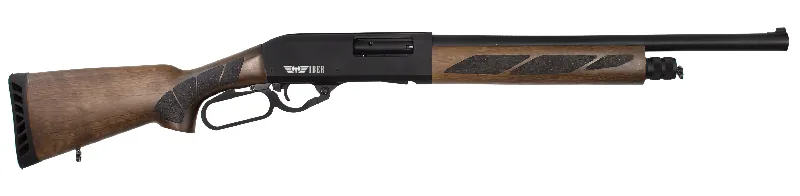
LEVER ACTION
Magazine Fed