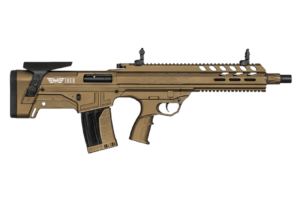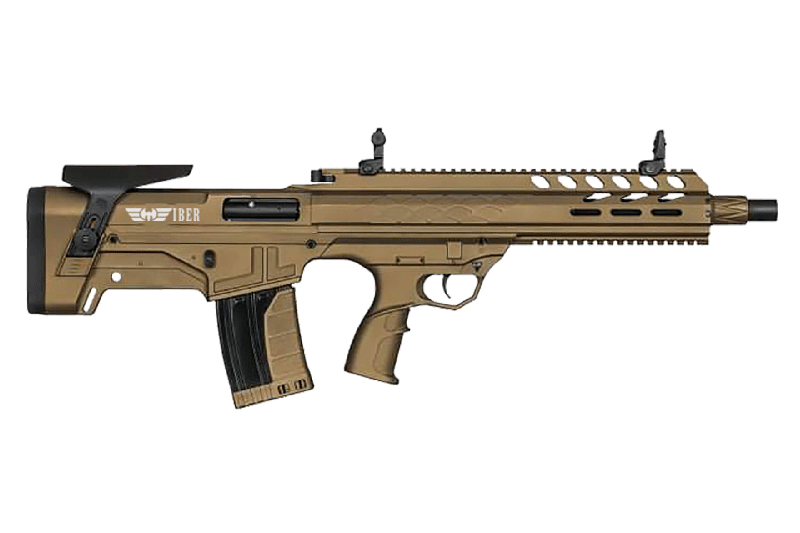
Before you buy a bullpup shotgun, or add one to a dealer’s shelf, check five things. Make sure the configuration is legal where it will be used, the trigger is acceptable, ejection suits left- and right-handed shooters, it feeds reliably with real ammunition, and magazines and spare parts are easy to get.
This guide comes from the technical and export team at Iber Arms, a shotgun manufacturer in Beyşehir, Türkiye. It expands those checks into a 12-point checklist and a test routine you can run on samples. For our models, specifications and legal notes by country, see the Iber Arms bullpup shotgun page.
The 12-point bullpup checklist
- 1. Job define the use before choosing action and capacity
- 2. Legality barrel length, overall length, action type and capacity for your market
- 3. Trigger pull weight, creep, reset and consistency across guns
- 4. Ejection side, conversion options and left-handed use
- 5. Reliability break-in and testing with your customers’ loads
- 6. Magazines quality, capacities and spare supply
- 7. Balance how it handles loaded and with accessories
- 8. Sights cheek weld, rail space and optics height
- 9. Controls safety, magazine release and charging handle under stress
- 10. Fit length of pull with real clothing and gear
- 11. Maintenance field-stripping, gas system and manual
- 12. Supplier samples, compliance answers, spares and batch consistency
1. Start with the job, not the gun
The use decides the action, capacity and barrel, and it tells you which of the later checks matter most.
| Main use | Action | Typical capacity | Barrel | Checks that matter most |
|---|---|---|---|---|
| Home and property defense | Pump or semi-auto | 5+1 is usually enough | 47 cm (18.5″) | Trigger, simple controls, ejection for every household shooter |
| Vehicle, boat and security | Semi-auto | 5+1 to 10+1 | 47 cm (18.5″) | Sling points, compact length, corrosion resistance |
| Law enforcement and military (authorized) | Semi-auto or pump | As specified | As specified | Reliability with duty loads, durability, training and parts support |
| Recreational and practical shooting | Semi-auto | 10+1 where legal | 47–51 cm (18.5–20″) | Reload speed, optics mounting, magazine supply |
2. Is it legal where it will be used?
Check four things, which are barrel length, overall length, action type and magazine capacity. In the US, a barrel of at least 18 in and an overall length of at least 26 in keep a shotgun outside the NFA short-barreled shotgun rules, and bullpups with 18.5-inch barrels can sit close to the 26-inch line, so measure the actual gun. In Great Britain, self-loading and pump-action smoothbores with a barrel under 24 in or an overall length under 40 in are prohibited. Canada limits semi-automatic shotgun magazines to 5 shells, and Australia and South Africa restrict semi-automatic shotguns further. Our country notes go into more detail. This is general information, so verify locally before you buy or import.
3. Test the trigger properly
The trigger is a common complaint about bullpups, because a linkage bar runs from the trigger back to the hammer and sear in the stock. With the gun confirmed unloaded, and using snap caps if the manual allows dry-firing, check the following points.
- Pull weight measure it with a trigger gauge and compare several guns, not one.
- Take-up and creep long, gritty travel before the break makes fast, accurate shots harder.
- Reset how far the trigger must travel forward before it is ready for the next shot.
- Consistency the pull should feel the same shot to shot and gun to gun within a batch.
Expect a bullpup to feel heavier than a conventional shotgun. What you are screening for is grit, inconsistency and excessive creep.
4. Check ejection and handedness
The ejection port sits beside the shooter’s cheek. On a right-ejecting bullpup, a left-handed shooter firing from the left shoulder risks being hit by hulls and gas. Ask which side the gun ejects, whether ejection can be converted and with which parts, whether a deflector is available, and whether the charging handle, safety and magazine release can be worked from either side. If many of your customers shoot left-handed, these answers decide the model.
5. Are bullpup shotguns reliable? Test it yourself
A bullpup is as reliable as its action, magazines and ammunition. Gas-operated models need a break-in and cycle best with full-power loads. A practical sample-test routine for dealers and importers looks like this.
- Clean off the factory preservative and lubricate as the manual describes.
- Break the gun in with a box or two of full-power shells, such as buckshot, slugs or heavy field loads.
- Fire at least two full magazines of each load your customers buy, including the lightest target load you plan to recommend.
- Use every magazine supplied. Number them and log any stoppage by magazine and load.
- Keep shooting without cleaning for a few hundred shells to see how fouling affects cycling.
- Record every failure to feed, eject or lock, and share the log with the supplier.
A gun that runs cleanly with your market’s common loads, through every magazine, after a few hundred shells is a gun you can sell with confidence.
6. Magazine quality, capacity and supply
Magazines are consumables and the biggest reliability variable on any box-fed shotgun. Inspect feed lips and followers, ask which capacities are offered (our bullpups take 2-, 5- and 10-round magazines), confirm they are rated for the shell length you sell, and make sure spares can be ordered at a reasonable cost. Plan on at least two or three magazines per gun, and dealers should keep capacities that are legal in their market in stock.
7–10. Balance, sights, controls and fit
7. Weight and balance
Bullpups carry their weight at the shoulder. That makes them easy to hold on target and to turn in confined spaces, but less natural to swing on crossing targets. Handle the gun with a full magazine and with any light or optic your customers will fit, and check the sling attachment points.
8. Sights and optics height
Because the cheek rests on the receiver, sights and optics sit on a rail above the action. Check that you get a consistent cheek weld with the iron sights and with a typical red-dot sight, and that there is rail space for a light. Our IB-BP01 and IB-BP02 have flip-up sights and a Picatinny rail.
9. Controls and manual of arms
Work every control (safety, magazine release, bolt release and charging handle) while wearing gloves and against the clock. On a bullpup they sit in different places from a conventional shotgun, so new owners need training time, and simpler controls mean fewer mistakes under stress.
10. Length of pull and fit
Most bullpups have a fixed length of pull because the action is in the stock. Check the fit for your typical customer, and for professional users with winter clothing or body armor; recoil pads or spacers, where offered, are the usual adjustment.
11–12. Maintenance access and supplier support
11. Maintenance access
Ask how the gun field-strips, how the gas system is cleaned and how the trigger linkage is reached. A gun that is easy to clean stays reliable. Make sure the manual is available in your customers’ language.
12. Questions dealers and importers should ask the manufacturer
- Can you send samples for evaluation before an order?
- Which configurations meet our market’s rules on barrel, overall length, capacity and features?
- Which proof marks and certificates are available for our market?
- Are spare parts and magazines available, and how are they ordered?
- How consistent are batches, and can we test guns from production as well as samples?
- Can you supply private-label markings, packaging and manuals?
- What are the warranty and returns terms?
Bullpup evaluation scorecard
Use this table to compare models side by side, ideally on the same day with the same ammunition.
| Criterion | What to test | Red flags |
|---|---|---|
| Legality | Barrel, overall length, capacity and action type for your market | A configuration that would need modification to be legal |
| Trigger | Pull weight, creep and reset across several guns | Grit; different pull from gun to gun |
| Ejection | Side, conversion options, deflector | No solution for left-handed shooters |
| Reliability | Break-in, every load, every magazine, after fouling | Stoppages tied to one load or one magazine type |
| Magazines | Feed lips, follower, spring, shell-length rating, availability | Cracked lips; no spare supply |
| Ergonomics | Controls, cheek weld, balance with accessories | Controls you cannot reach without breaking your grip |
| Maintenance | Field-stripping, gas-system cleaning, manual | Special tools needed; no manual in your language |
| Supplier | Samples, compliance answers, spares, batch consistency | No samples; vague answers on compliance |
Is a bullpup shotgun good for home defense?
It can be. The short overall length makes it easier to move through doorways and hallways without giving up barrel length. But it is not automatically the best choice. Reloads and stoppage clearance take more practice, left-handed household members need suitable ejection, and the blast close to the face is noticeable indoors. Owners who train regularly can benefit from the compact size, while those who will not are often better served by a conventional pump or semi-auto. Home-defense use must always comply with local law, including storage rules.
What about a .410 bullpup shotgun?
A .410 bullpup offers very light recoil in a compact package, which appeals to recoil-sensitive shooters and for pest control. The trade-off is payload. A .410 shell carries far less shot than a 12 gauge, so it is less effective for defense and longer shots, and .410 shells are often more expensive. Iber’s bullpups are 12 gauge. For a .410 semi-auto with a box magazine in a conventional layout, see the IB-MF20, or compare every option on our .410 shotguns page.
So what is the best bullpup shotgun?
There is no single best bullpup shotgun, only the best one for a particular user and market. For most buyers, that is the model that is legal where it will be used, has a trigger and ejection setup its shooters can live with, runs reliably with locally available ammunition and is backed by magazines and parts. For dealers, add consistent batches and a supplier who answers compliance questions clearly. Run the checklist above on samples and compare models with the same ammunition.
Bullpup buying FAQ
Are bullpup shotguns harder to learn than conventional shotguns?
A little. Pointing and carrying come naturally, but reloading, clearing stoppages and finding the controls take practice because the magazine and action sit behind the grip. Plan for training time, especially for owners moving from a pump or conventional semi-auto.
Can left-handed shooters use a bullpup shotgun?
Only if the ejection suits them. On a right-ejecting bullpup fired from the left shoulder, hulls and gas come out next to the face. Look for models with convertible or forward ejection, or a deflector, and test before buying.
Should I choose a pump or a semi-auto bullpup?
A pump works with any load and is mechanically simple; a semi-auto gives faster follow-up shots and lower felt recoil but needs full-power loads, a break-in and clean magazines. Semi-autos are the more common choice for practical shooting; for owners who want simplicity, a pump is worth considering.
How many magazines should I buy with a bullpup shotgun?
At least two or three per gun, in a capacity that is legal where you live. Spare magazines let you rotate them, carry a reload and keep shooting if one is damaged.
Can I buy a bullpup shotgun directly from Iber Arms?
Only as a licensed business. Iber Arms supplies importers, distributors, licensed dealers and government buyers, not private individuals. Shooters should ask a licensed dealer or importer in their country.
Evaluating bullpups for your market?
See the IB-BP01 and IB-BP02 on our bullpup shotgun manufacturer page, then send an inquiry for samples, compliant configurations and a quote. You can also browse our magazine fed shotguns or download our catalogs.
Reviewed by the Iber Arms technical & export team, October 2026.